Probability Assessment as the Divider Between Skill-Based Games and Pure Chance Activities
Harper Lehmann · Aug 8, 2026
Probability Assessment as the Divider Between Skill-Based Games and Pure Chance Activities
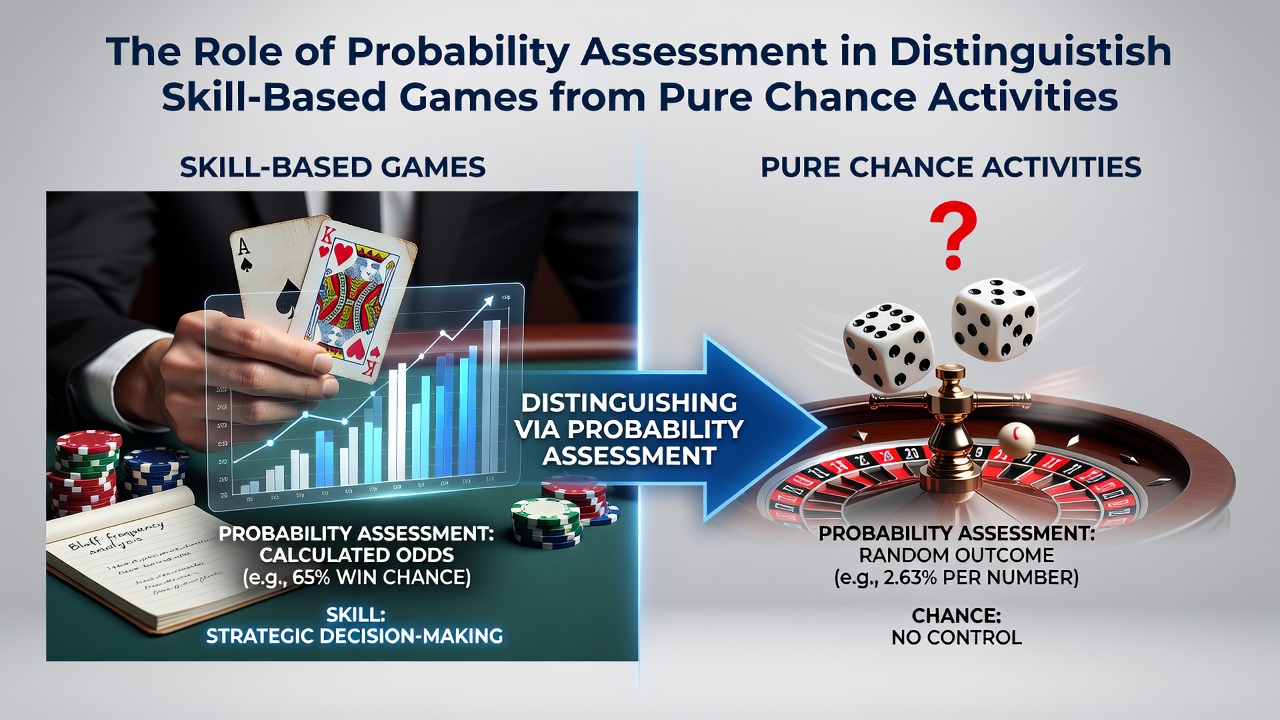
Probability assessment serves as the central mechanism for categorizing games into those dominated by skill and those defined by pure chance, and regulators along with analysts rely on mathematical models to draw these lines, while data from controlled studies continue to refine the boundaries. Observers note that in pure chance activities every outcome rests on fixed probabilities that no player action can alter, whereas skill-based formats allow decisions to shift those probabilities over repeated plays.
Researchers at institutions such as the University of Nevada, Reno have documented how variance calculations and expected outcome distributions separate the two categories, and figures released in their 2025 reports show measurable edges emerging only when players apply consistent strategic choices. Those edges remain invisible in games like roulette or slot machines where each spin or roll operates independently of prior results.
Mathematical Foundations That Separate the Categories
Analysts begin with the law of large numbers and conditional probability when evaluating any game format, and they calculate long-run returns under optimal play versus random selection to reveal whether skill can produce statistically significant deviations from house percentages. In skill-based formats such as certain card games, players track remaining cards and adjust bets accordingly, which changes the probability distribution for subsequent hands, yet in pure chance games those adjustments produce no measurable shift.
Studies compiled by the Australian Institute of Family Studies in mid-2025 illustrate this distinction through simulation data, where thousands of trials demonstrated flat return curves for chance-only mechanics and sloping improvement curves once decision trees enter the model. Observers note that these curves become the evidentiary basis for legal classifications in multiple jurisdictions.
Regulatory Applications Across Jurisdictions
Gaming control boards in Nevada and New Jersey apply probability thresholds when licensing new table games or electronic formats, and they require operators to submit detailed return-to-player models that isolate the skill component. When the skill element exceeds a defined percentage threshold, the game receives a different regulatory treatment than slot-style chance devices. Similar frameworks operate in Canadian provinces where provincial gaming authorities review independent lab certifications before market entry.
Data collected through 2025 and into August 2026 continues to inform these reviews, with updated simulation protocols now incorporating player behavior logs from licensed venues. Regulators use the resulting datasets to confirm that claimed skill advantages hold across large sample sizes rather than appearing in isolated short sessions.
Practical Examples in Common Game Formats
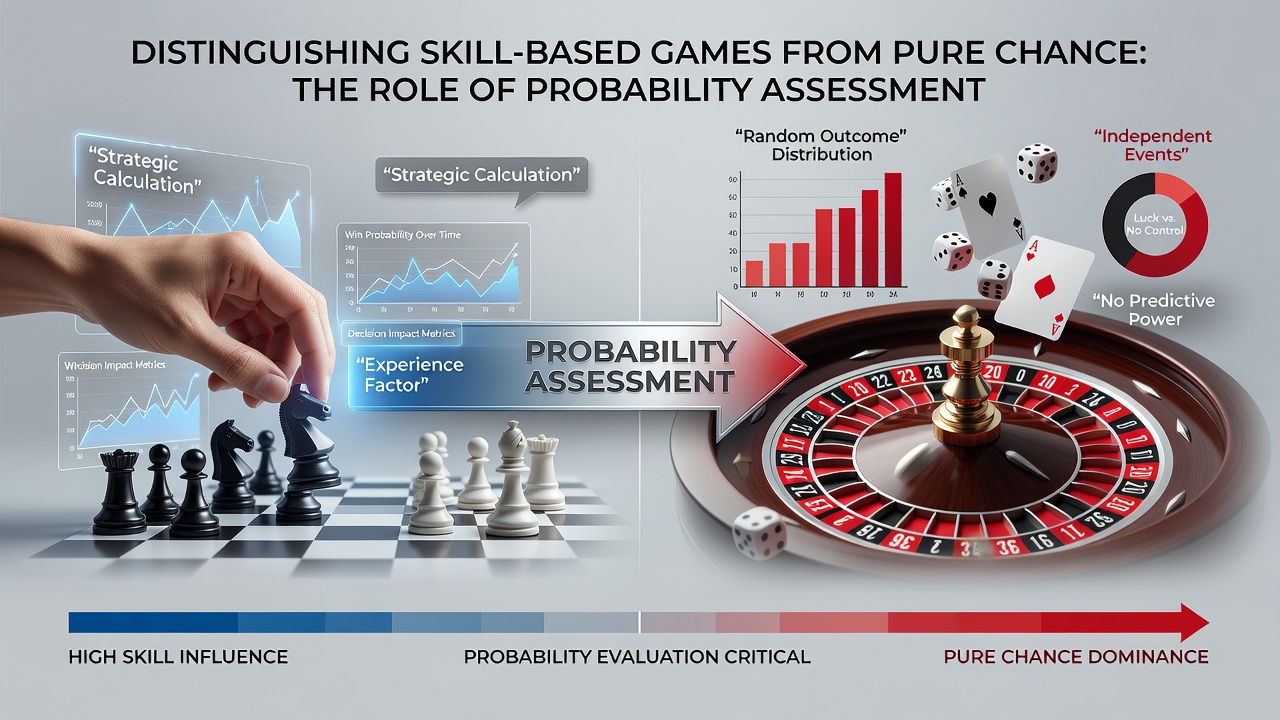
Blackjack provides a clear case where card counting and basic strategy shift the probability of favorable outcomes, and multiple academic papers have quantified the reduction in house edge from roughly 2 percent under random play to under 0.5 percent with optimal decisions. In contrast, craps pass-line bets maintain a fixed 1.36 percent disadvantage regardless of any betting system because each roll remains an independent event governed by unchanging dice probabilities.
Poker variants further demonstrate the role of assessment because success depends on reading opponents and calculating pot odds in real time, and tournament data released by major circuit organizers show that top performers sustain positive returns over thousands of hands while random participants converge toward the mean. Pure chance activities lack any comparable performance stratification once sample sizes grow large.
Challenges in Modern Assessment Methods
Hybrid games that blend random number generators with player choice create assessment difficulties, and laboratories must now run Monte Carlo simulations that isolate the random element from decision layers to produce accurate classifications. Updates scheduled for release in August 2026 by independent testing firms introduce new variance metrics designed to handle these blended formats without mislabeling them as either pure skill or pure chance.
Those metrics incorporate player decision trees alongside RNG output distributions, and early validation trials indicate improved accuracy in identifying the true contribution of skill across repeated sessions. Regulators in several U.S. states have already signaled intent to adopt the revised protocols once final peer review concludes.
Conclusion
Probability assessment remains the objective standard for distinguishing skill-based games from pure chance activities because it supplies measurable, replicable data on whether player decisions can alter long-term outcomes. As simulation techniques and regulatory data collection advance through 2026, the separation between the two categories grows more precise, supporting consistent policy decisions across different markets.