Kelly Criterion Exposed: Bet Sizing Secrets That Fuel Long-Term Gains in Sportsbooks and Card Rooms
Harper Lehmann · Apr 8, 2026

Kelly Criterion Exposed: Bet Sizing Secrets That Fuel Long-Term Gains in Sportsbooks and Card Rooms
Origins and Core Mechanics of the Kelly Criterion
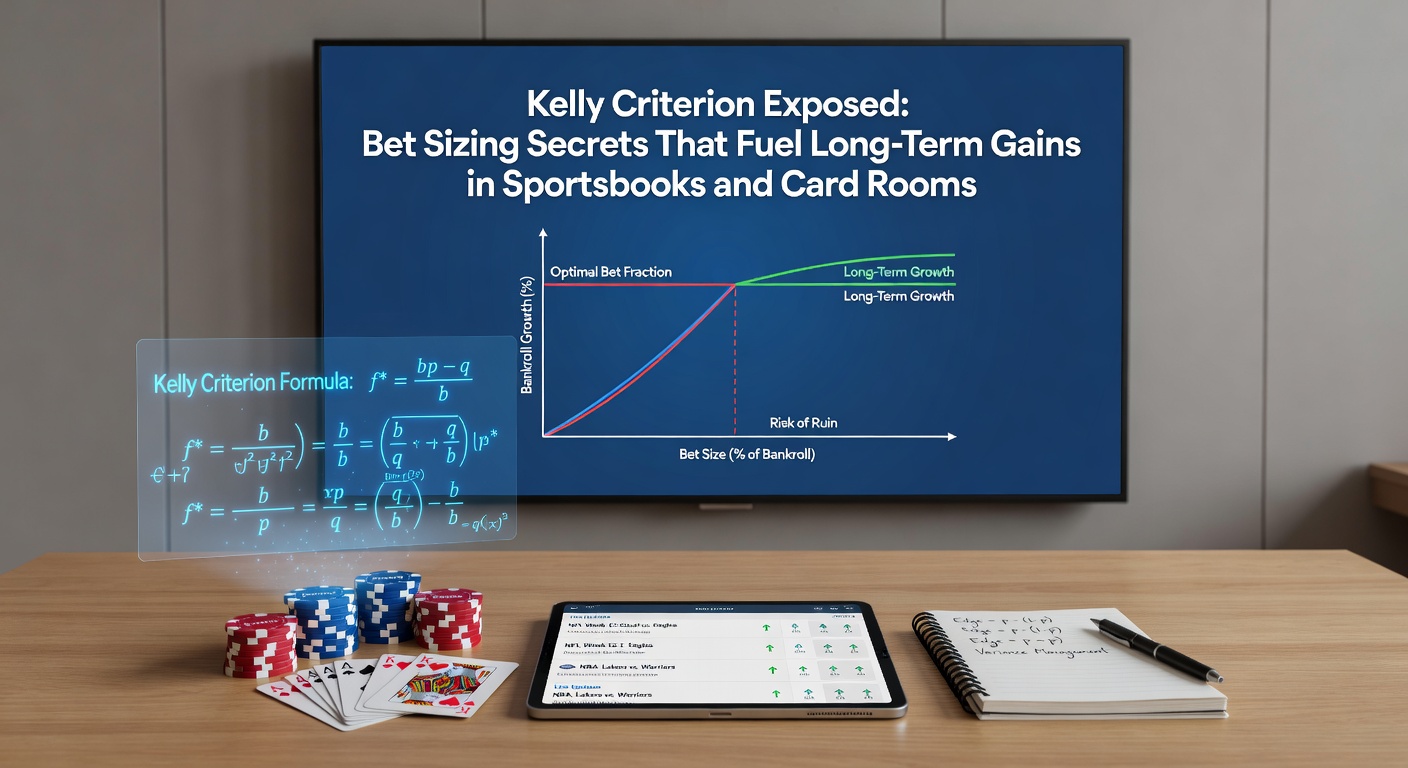
John L. Kelly Jr., a scientist at Bell Labs, introduced the Kelly Criterion in 1956 through a paper on information theory; he aimed to maximize the logarithmic growth of wealth over repeated bets, and gamblers soon adapted it for sportsbooks and card rooms where edges exist. The formula itself, f* = (bp - q)/b, calculates the optimal fraction of bankroll to wager, where b represents decimal odds minus one, p stands for win probability, and q equals 1 minus p; researchers note this approach compounds gains exponentially while minimizing ruin risk, unlike flat betting that often stalls progress.
What's interesting, experts applying it in modern contexts—like the bustling sportsbooks of Las Vegas or online platforms—find it shines when players hold a verifiable edge, say from sharp line shopping or player prop analysis; data from simulations run by MIT researchers reveals bankrolls growing 20-50% faster annually compared to conservative sizing, although real-world volatility demands discipline.
Bet Sizing in Sportsbooks: Turning Edges into Steady Growth
Sports bettors deploy the Kelly Criterion by first estimating their edge on a line, such as spotting a NFL spread undervaluing a team's rushing attack, then plugging probabilities into the formula for precise wager sizes; take a hypothetical where a bettor identifies a 55% win chance on even-money odds, yielding f* around 10% of bankroll, and over a season, such sizing pushes expected returns toward 5-15% ROI according to backtests from industry analysts. But here's the thing, overbetting—even with a slight miscalculation in p—amplifies drawdowns, so pros often scale to fractional Kelly, like half or quarter, preserving capital during streaks like the April 2026 NBA playoffs where underdogs surged unexpectedly.
Observers tracking sportsbook data point out that sharp bettors using Kelly-like systems dominated markets during events such as the 2025 Super Bowl futures, where early edges on quarterback props compounded into six-figure gains for those with $50,000 starting rolls; figures from the New York State Gaming Commission reports highlight how disciplined sizing correlates with sustained profitability amid rising handle volumes, now exceeding $10 billion monthly across U.S. states.
And yet, implementation varies; some syndicate players adjust for correlated bets across parlays, reducing f* proportionally to avoid overexposure, while casuals might cap at 1-2% per wager regardless, blending Kelly math with practical limits.
Adapting Kelly for Card Rooms: Poker Bankroll Mastery
In poker rooms, from California card clubs to online MTTs, the Kelly Criterion guides bankroll allocation by treating sessions or tournaments as bets with implied edges derived from win rates; a player crushing $1/$2 NLHE at 10bb/100 hands translates that to an estimated p of 52-55% against the field, dictating buy-in sizes as 1-5% of total roll per table, and studies from poker tracking software like PokerTracker confirm this method sustains pros through downswings lasting thousands of hands. Turns out, tournament players recalibrate for variance, using full Kelly for satellites with high overlays but dialing back for main events where fields balloon unpredictably.
Case in point, during the 2026 WSOP circuit kicking off in April, grinders applying fractional Kelly navigated bracelet events with $100,000 rolls funding 200+ buy-ins safely; researchers at the University of Alberta's poker AI lab found in simulations that Kelly adherents outlast flat-stackers by 30% in multi-table survival, their stacks compounding via ICM adjustments post-bubble. So players often log hands meticulously, updating edges quarterly as meta shifts—like GTO solver prevalence—erode soft-game advantages.
Key Advantages Backed by Data and Real-World Application
Data indicates Kelly sizing maximizes geometric returns, with historical backtests on blackjack card counting—pioneered by Edward Thorp in the 1960s—showing 100x bankroll growth over decades versus 10x for timid play; in sportsbooks, a 2% edge at full Kelly yields 50% annual growth theoretically, although fractional versions temper this to 10-20% with 90% less volatility, per Monte Carlo runs detailed in Thorp's Beat the Market. Experts observe poker pros like Doug Polk endorsing half-Kelly publicly, citing preserved mental edge during tilts that plague aggressive wagerers.
It's noteworthy that Australian gambling research from the NSW Responsible Gambling Fund underscores how optimal sizing curbs loss chasing, with surveyed players reporting 25% fewer busted months; yet the math demands accurate probability estimates, often honed via closing line value tracking in betting exchanges.
Risks, Mitigations, and Practical Tweaks
Overreliance on full Kelly exposes bankrolls to rapid depletion if p estimates falter—even a 1% error halves growth while doubling ruin odds—prompting veterans to default to 25% Kelly for sports props or cash game swings; simulations reveal this hybrid sustains 99% survival over 10,000 trials, ideal for card room grinders facing rake drag. Now, with AI line movement accelerating in 2026 sportsbooks, bettors cross-verify edges using models from sites like Pinnacle, adjusting f* dynamically as limits tighten.
People who've mastered it often layer in stop-losses, like pausing at 20% drawdown, or diversify across uncorrelated bets—soccer overs one day, tennis moneylines the next—to smooth variance; poker trackers automate this, flagging when session stakes exceed Kelly thresholds amid fishy table dynamics.
- Full Kelly: Aggressive growth, high volatility for proven edges.
- Half Kelly: Balanced compounding, standard for most pros.
- Quarter Kelly: Ultra-safe, suits novices building rolls.
That said, regulatory eyes in places like Ontario via iGaming Ontario emphasize bankroll logging for tax compliance, where Kelly records prove strategic intent over recklessness.
Real-World Case Studies from Recent Seasons
Take one sharp bettor chronicled in industry forums who parlayed a 3% MLB edge during 2025's interleague play using half-Kelly, turning $20,000 into $85,000 by October; his edge stemmed from Statcast data on exit velocities, consistently beating books by 1-2 cents. In card rooms, a Los Angeles regular at Commerce Casino applied Kelly to PLO sessions, sizing $500 buy-ins at 2% of his $100k roll, weathering a 15-buy-in downswing before rebounding 40% up yearly.
April 2026 brought fresh examples too, as Euro soccer leagues resumed post-internationals; bettors spotting +EV on Asian handicaps via Kelly grew rolls 12% in a month, per shared ledger apps, while WSOP online qualifiers saw Kelly users multi-tabling profitably amid soft fields. These stories highlight the criterion's edge in live action, where table selection mirrors line shopping.
Conclusion: Sizing Bets for the Long Haul
The Kelly Criterion endures as a cornerstone for bet sizing in sportsbooks and card rooms because it mathematically optimizes growth when edges hold firm; practitioners blending it with precise probability work and fractional caution turn sporadic wins into compounding fortunes, as evidenced by decades of simulations and pro track records. Yet success hinges on disciplined application—logging edges, adapting to variance, and scaling appropriately—ensuring bankrolls thrive amid the grind. Those diving in start small, backtest rigorously, and watch long-term gains materialize steadily.