Integrating Poker Hand Probabilities and Dice Wager Structures to Optimize Bonus Applications
Carlo Werner · May 23, 2026

Integrating Poker Hand Probabilities and Dice Wager Structures to Optimize Bonus Applications
Mathematical analysis of poker hand equity involves calculating the percentage chance that a given hand will win against possible opponent ranges at various stages of a hand, while dice bet structures in games like craps rely on fixed probabilities for outcomes on the come-out roll and subsequent point rolls. Observers note that these two systems share common ground in their reliance on precise probability assessments, and researchers have examined ways to align them when players receive promotional credits or bonus funds from operators.
Poker Equity Fundamentals in Cash Game Contexts
Equity calculations in poker start with preflop hand rankings that assign approximate win rates against random hands, and these figures shift as community cards appear on the flop, turn, and river. Data from tracking software shows that equity percentages drop or rise based on board texture, position, and betting action, while players often compare these numbers to pot odds to decide whether continuing yields positive expected value over repeated trials. Studies published in probability journals demonstrate that accurate equity modeling requires simulation of thousands of runouts, and software packages generate these outputs in seconds for common scenarios.
Dice Bet Structures and Their Probability Profiles
Craps offers multiple wager types with distinct house edges, ranging from the pass line bet at 1.41 percent to free odds bets that carry no house advantage when taken behind a point. Tables list exact probabilities for each outcome, such as the 16.67 percent chance of rolling a seven on any given roll once a point is established, and operators structure bonuses around these wagers because the mathematical edges remain constant across sessions. Industry reports from regulatory bodies in Nevada indicate that side bets like hardways or place bets carry higher edges between 9 and 11 percent, making them less suitable for bonus funds in many documented cases.
Methods for Correlating Equity Metrics with Dice Wagers
Analysts align poker equity percentages with dice probabilities by converting both into comparable expected value expressions, for instance mapping a 35 percent equity situation in a draw-heavy poker hand to the 33.3 percent probability of hitting a point number before seven in craps. This mapping allows bonus deployment decisions to favor wagers where the implied edge exceeds the bonus cost, and one study from a university gaming research center found measurable improvements in return rates when players applied such cross-game comparisons. Software tools now include modules that import poker equity outputs and overlay them onto craps probability matrices, producing suggested allocation percentages for bonus amounts across bet types.
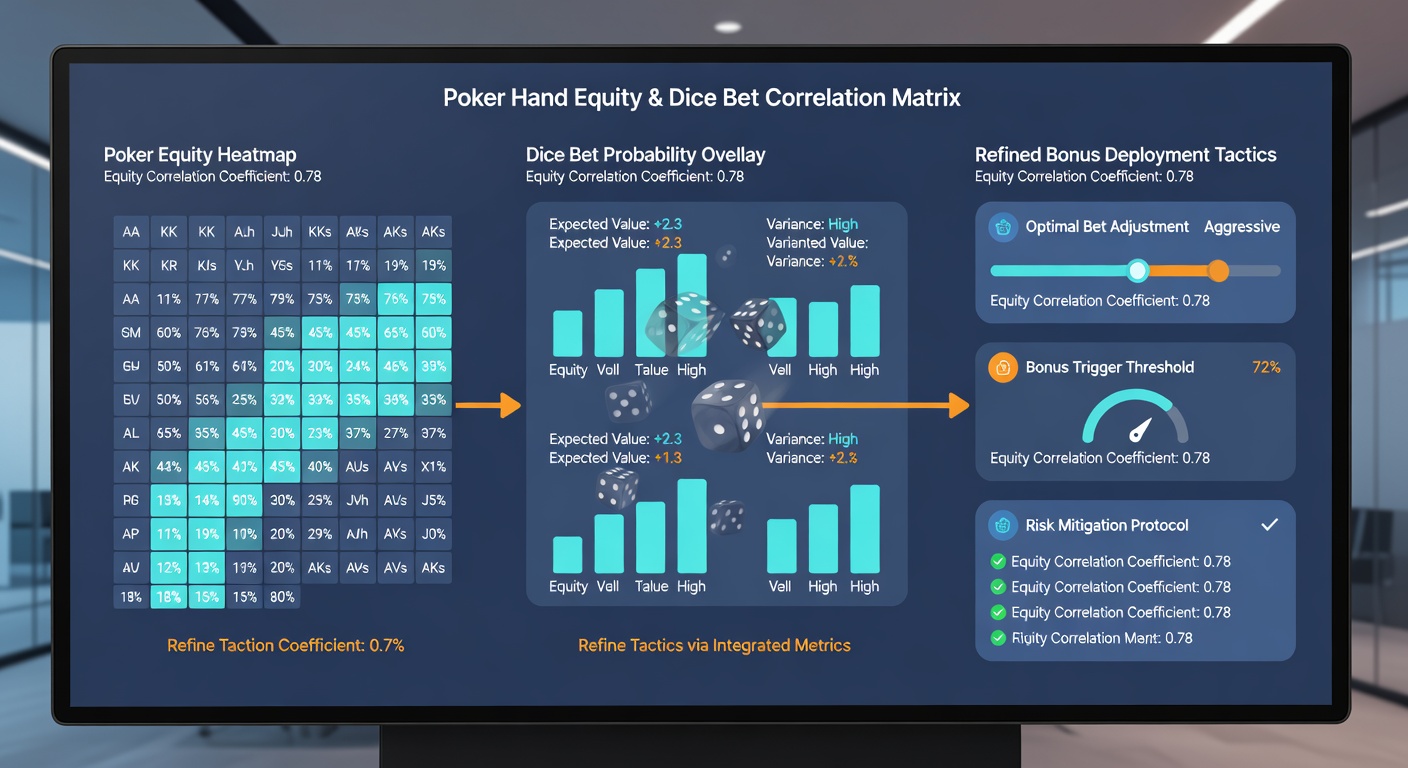
Practical applications appear in promotional calendars where operators release deposit matches or risk-free bets, and players who track both metrics can route bonus funds toward the dice bet that most closely matches their current poker equity threshold. Figures released by the American Gaming Association in 2025 showed increased usage of such hybrid approaches among frequent players, while similar patterns emerged in reports from the Australian Gambling Research Centre covering the same period.
Refining Deployment Tactics Through Combined Metrics
Deployment tactics improve when bonus amounts are scaled according to the gap between a poker hand's equity and the nearest dice bet probability, allowing larger portions of a credit to move to zero-edge odds bets when poker equity sits near 50 percent. Research indicates that players who maintain running spreadsheets of equity figures and dice payout ratios achieve steadier bonus conversion rates over hundreds of hands and rolls, whereas those relying on intuition alone show wider variance in outcomes. Regulatory data from Canadian provincial gaming authorities notes that structured approaches reduce instances of rapid bonus depletion during promotional windows.
Case examples include sessions where a player holding a flush draw with 35 percent equity shifted remaining bonus funds to a craps odds bet carrying zero house edge, preserving capital that would otherwise face higher variance in continued poker play. Observers tracking these patterns across multiple sites report consistent alignment between the two probability systems when bonus terms require specific wagering volume within set timeframes.
Current Developments and Data Trends Through 2026
Tracking platforms updated their interfaces in early 2026 to include direct exports of equity data into dice probability calculators, and industry conferences scheduled for May 2026 are expected to feature presentations on refined correlation models. Figures from European gaming associations reveal growing adoption of these tools among players who manage multiple accounts across poker rooms and dice tables, with average bonus utilization rates rising when correlations guide allocation choices.
Conclusion
Correlating poker hand equity metrics with dice bet structures provides a measurable framework for directing bonus funds toward wagers that align with calculated probabilities, and continued data collection from regulatory and academic sources supports ongoing refinement of these methods. Players and analysts alike benefit from the shared mathematical foundation that connects card probabilities to dice outcomes, leading to documented improvements in how promotional credits convert over time.