Decoding Player Edge Calculations Across Table Games and Wagering Markets When Layered With Promotional Structures
Iris Otto · Jul 16, 2026

Decoding Player Edge Calculations Across Table Games and Wagering Markets When Layered With Promotional Structures
Player edge calculations form the foundation for evaluating returns across table games and broader wagering markets, especially when operators layer in promotional structures such as deposit matches, cashback programs, and free bet credits. These calculations start with the mathematical house edge embedded in each game or market, then adjust for the impact of bonuses that temporarily shift the effective return to the participant.
Base Edge Mechanics in Table Games
Table games carry fixed house edges determined by rules and payout structures, and observers note that blackjack variants with optimal basic strategy often sit near 0.5 percent when the dealer stands on soft 17, while American roulette double-zero wheels maintain a 5.26 percent edge on straight-up bets. Craps pass line wagers deliver a 1.36 percent house edge under standard rules, and these figures come from combinatorial analysis that enumerates every possible outcome against the payout matrix. Data from the Nevada Gaming Control Board shows that aggregate hold percentages across all table games in the state hovered between 2.8 and 4.1 percent during the 2025 fiscal year, reflecting a blend of player skill levels and rule variations.
Experts calculate player edge as the negative of the house edge when no promotions apply, yet the moment a bonus enters the equation the net figure changes because the promotional value must be amortized across the required wagering volume. Those who model these adjustments divide the bonus amount by the playthrough multiplier and subtract the result from the base house edge to derive an updated expected return.
Integration With Sports and Wagering Markets
Wagering markets introduce variable odds that fluctuate with line movement and market liquidity, and researchers at academic institutions such as the University of Nevada, Las Vegas track how closing line value correlates with long-term profitability for informed bettors. A standard point-spread bet carries a 4.76 percent house edge at -110 odds, while moneyline markets on underdogs can produce edges below 3 percent when sharp action moves the number. Promotional free bets or enhanced odds function similarly to table-game bonuses by injecting additional expected value that offsets the base edge for a limited number of wagers.
Market data compiled by the Canadian Gaming Association indicates that sports betting hold percentages averaged 5.2 percent across major North American operators in early 2026, yet promotional overlays reduced the effective hold to 3.1 percent for accounts that fully utilized sign-up offers during the same period. July 2026 regulatory filings from several provincial gaming authorities further revealed that cashback promotions on parlays produced the largest edge reduction when multipliers stayed under 5x, because the bonus contribution to expected value outpaced the additional risk incurred.
Promotional Layering and Effective Edge Formulas
Promotional structures require precise amortization because operators tie bonuses to playthrough requirements that multiply the original deposit or bonus amount. The standard formula subtracts the amortized bonus value from the base house edge and adds any additional return from cashback percentages, yielding a revised player edge that can turn positive when the bonus exceeds the expected loss on the required volume. Industry reports from the European Gaming and Betting Association document that reload bonuses with 4x playthrough on blackjack produced effective edges between -0.2 and +1.1 percent depending on game selection and cashback tier during the first half of 2026.
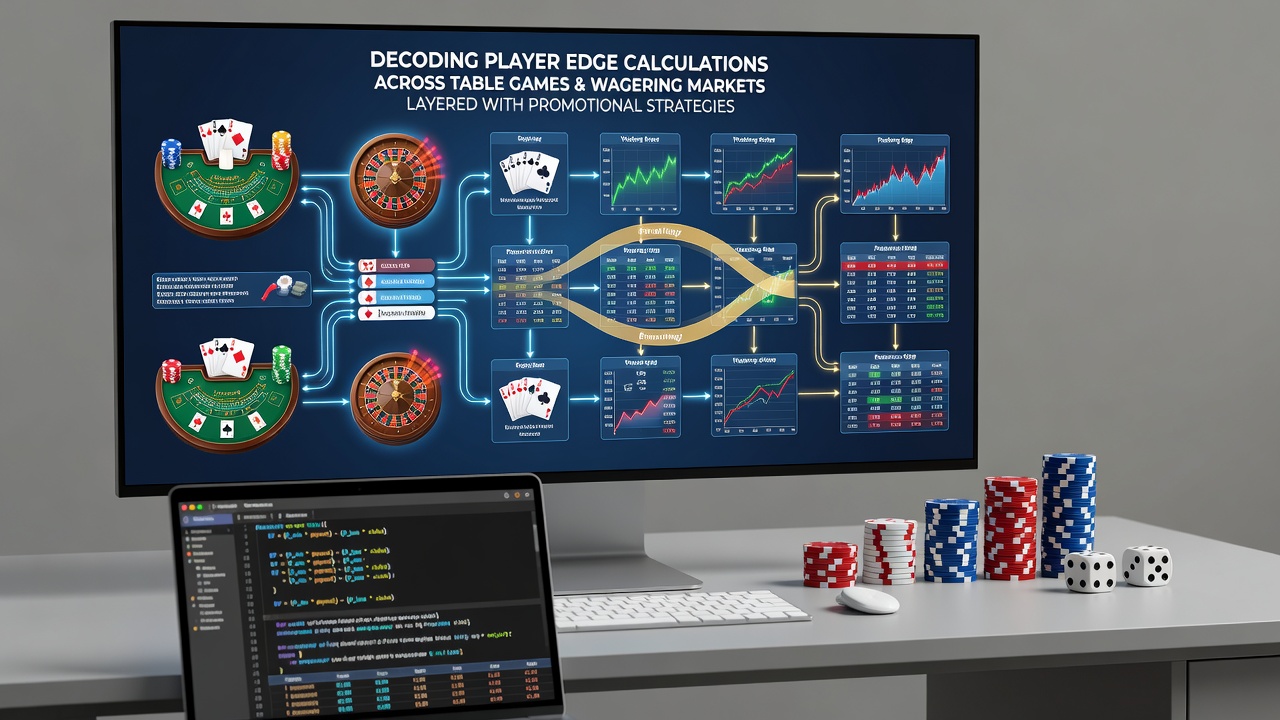
Observers note that combining multiple promotions, such as a deposit match plus weekly cashback, demands sequential calculation steps because each layer interacts with the others through overlapping wagering requirements. Those who model these interactions apply the bonus value first, then layer cashback as a percentage of net losses, which further compresses the effective edge until the total promotional contribution surpasses the cumulative house edge across all games played.
Practical Calculation Examples Across Formats
Consider a blackjack player who receives a $200 deposit match with a 30x playthrough requirement. The $200 bonus must be wagered 30 times, creating $6,000 in total action. At a 0.5 percent house edge the expected loss on that action equals $30, so the net player edge after the bonus becomes positive $170 before any cashback. Adding a 10 percent cashback on losses further improves the figure because the cashback returns $3 on the $30 expected loss, trimming the effective house edge to roughly 0.45 percent across the full cycle.
In sports markets the same logic applies when a free bet credit of $50 requires 5x playthrough on decimal odds of 1.91. The credit generates expected value equal to the stake multiplied by the edge differential, and analysts adjust for the fact that the free bet itself carries no risk to the player while still counting toward the requirement. Australian wagering operators reported in mid-2026 filings that free bet promotions on rugby league markets reduced effective hold percentages by 1.8 points on average when the underlying odds sat near even money.
Conclusion
Player edge calculations evolve continuously as operators introduce new promotional mechanics and regulators adjust disclosure rules across jurisdictions. Accurate modeling requires separating base mathematical edges from the temporary offsets created by bonuses, cashback, and free bet credits, then recombining those elements through amortization formulas that reflect actual playthrough volume. Data from multiple regulatory bodies and academic sources demonstrates that these layered adjustments can shift expected returns measurably, provided participants track wagering requirements and game selection with precision.