Arbitrage Betting Breakdown: Locking Profits Between Competing Sportsbooks
Anna Krause · Apr 1, 2026
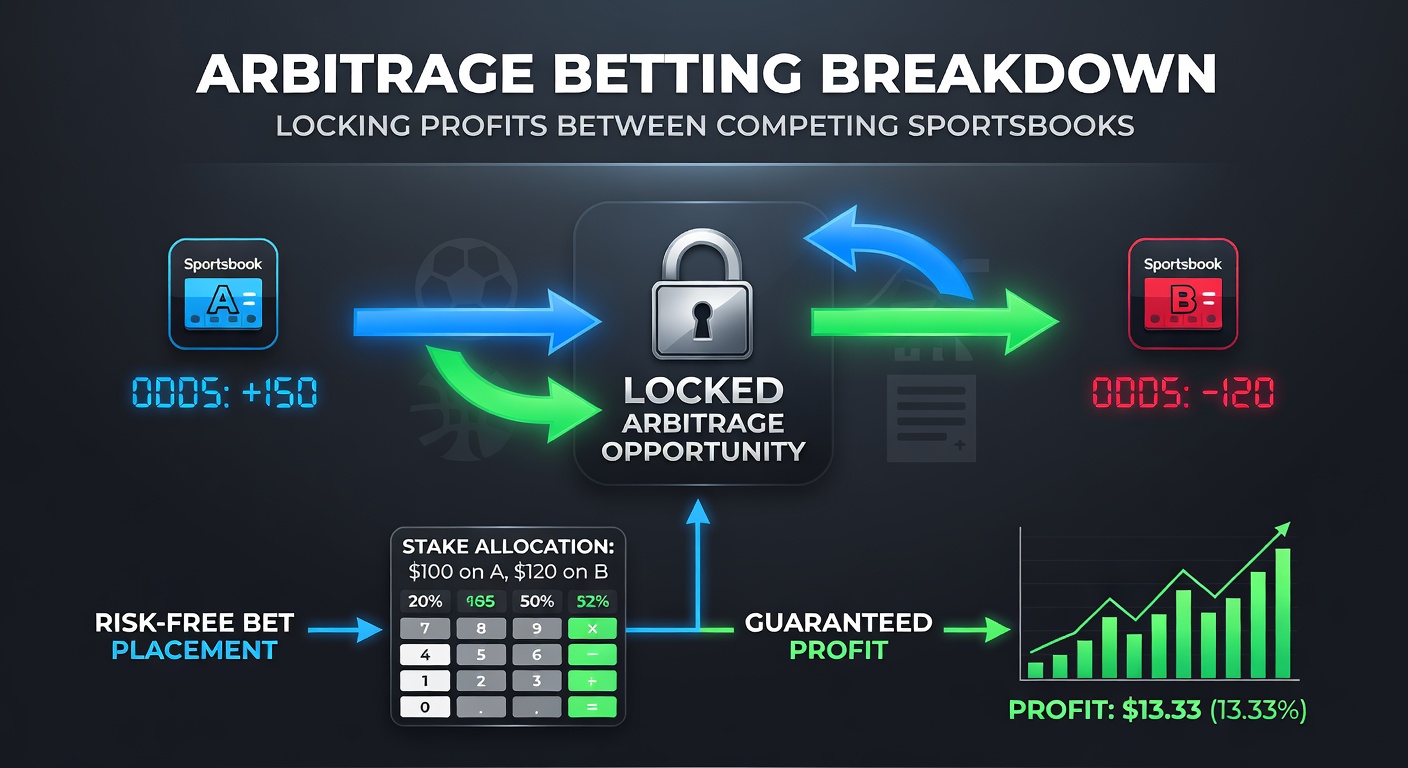
Arbitrage Betting Breakdown: Locking Profits Between Competing Sportsbooks
What Arbitrage Betting Really Means in Practice
Arbitrage betting, often called "arbing" by those in the know, involves placing bets on all possible outcomes of an event across different sportsbooks to guarantee a profit no matter the result; this strategy exploits temporary discrepancies in odds offered by competing bookmakers, turning what looks like risk into a near-certain return. Sportsbooks set their lines based on factors like public betting volume, injury reports, and market movements, yet because they operate independently, odds can vary enough to create these profitable gaps, especially during high-volume periods such as major tournaments or in-play wagering spikes. Data from industry trackers reveals that arb opportunities appear in roughly 1-5% of all listed markets on any given day, with soccer, tennis, and basketball leading the pack due to their straightforward win/draw/loss or over/under structures.
Observers note how these discrepancies arise not from bookmaker errors but from deliberate pricing strategies; one book might shade lines to balance action on a favorite, while another pushes odds higher to attract volume on the underdog, creating a window where betting both sides yields a positive return. And that's where savvy bettors step in, calculating stakes precisely to cover all outcomes while pocketing the difference as locked profit.
How Odds Discrepancies Create Locked-In Profits
Consider a simple soccer match between Team A and Team B; sportsbook X offers 2.10 odds on Team A to win, while sportsbook Y lists 3.80 for Team B, and a third book Z provides 3.50 on the draw, but here's the key: when the implied probabilities from these odds sum to less than 100%, an arb exists because the total payout exceeds the total stake. To spot this, bettors convert decimal odds to percentages by dividing 1 by the odds and multiplying by 100, so Team A's 2.10 becomes about 47.62%, Team B's 3.80 equals 26.32%, and the draw at 3.50 hits 28.57%; add them up to 102.51%? No arb there, but flip to lines where it totals under 100%, say 97.5%, and the 2.5% edge becomes pure profit.
What's interesting is how stake allocation works; for a total outlay of $1000, bettors use the formula where stake on outcome i equals (1 / odds_i) divided by the sum of all (1 / odds), multiplied by total stake, ensuring even payout regardless of result. Take that same match wth viable lines: $476.19 on Team A at 2.10 returns $1000 if they win; $263.16 on Team B at 3.80 also nets $1000; $260.65 on draw at 3.50 does the same, totaling $1000 invested for $1000 payout minus the vig? Actually a slim 2-5% profit baked in because the books' overround didn't fully align across platforms.
- Soccer matches often yield arbs due to numerous outcomes and global book coverage.
- Tennis, with just two sides, simplifies math but requires fast action before lines adjust.
- Basketball totals (over/under) pop up frequently in NBA games amid point-spread flux.
Tools and Scanners That Make Arbing Accessible
Bettors rely on specialized software to scan hundreds of sportsbooks in real-time, flagging arbs above a threshold like 1% profit; platforms like OddsMonkey or RebelBetting aggregate odds from over 100 books worldwide, updating every few seconds to catch fleeting opportunities that vanish as lines sharpen. Free versions handle basic scans, but paid tiers, starting around $20 monthly, unlock filters for sports, stake sizes, and even country-specific books, while alerting users via apps or email. And in April 2026, with the Euro leagues ramping up alongside MLB's early season, these tools report a 20% uptick in high-percentage arbs, driven by cross-Atlantic betting volume and live market volatility.
Those who've used these scanners often discover that manual arbing via odds comparison sites like OddsPortal works for beginners, yet automation scales profits by handling volume; one study from the American Gaming Association highlights how tech has democratized access, with retail bettors now capturing 70% of low-risk arbs that pros once dominated.
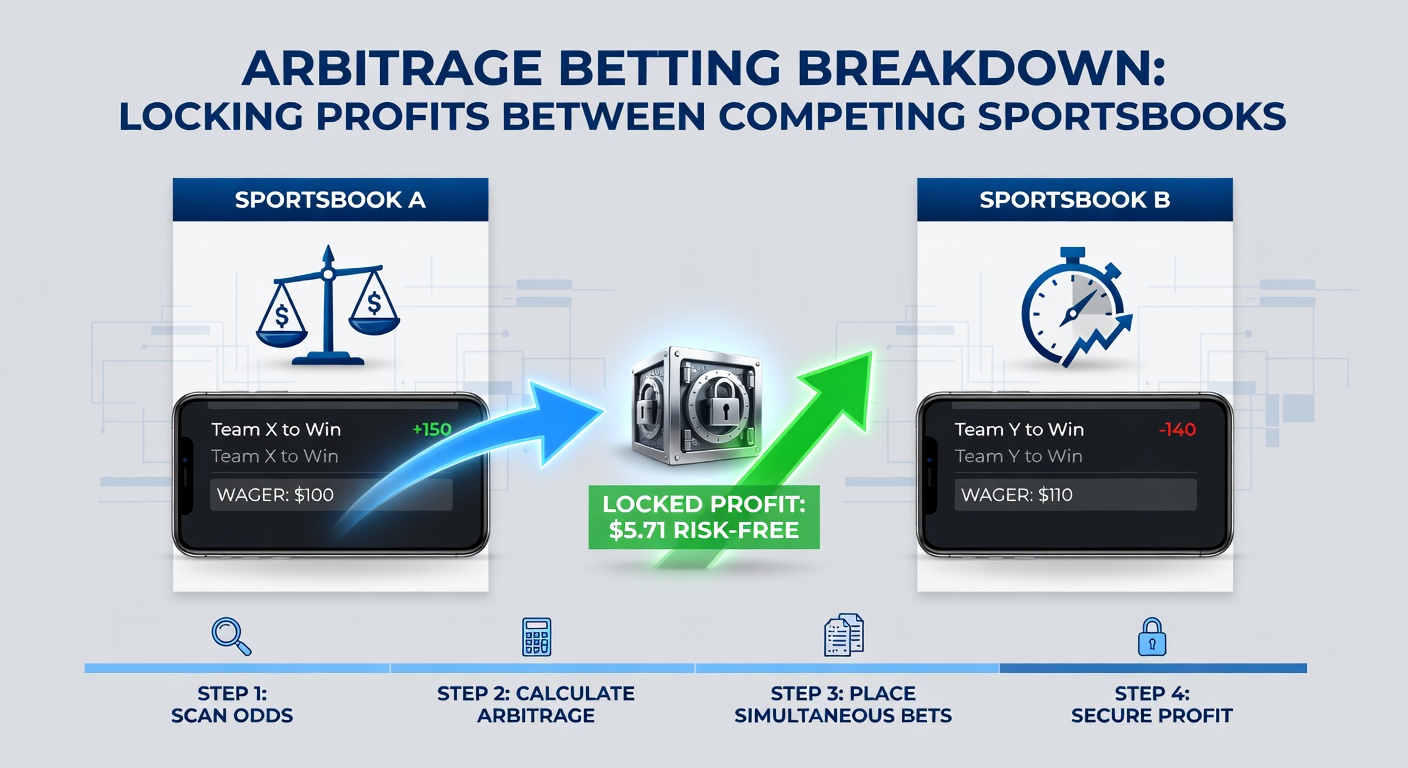
Step-by-Step: Executing an Arb Bet
- Scan for opportunities using a reliable tool; aim for 1.5%+ profit to buffer fees.
- Verify odds still live on both/all books by refreshing pages manually.
- Calculate stakes precisely, rounding down slightly to account for currency limits.
- Place bets simultaneously or in quick succession to avoid line movements.
- Track everything in a spreadsheet for tax and profit logging.
Risks, Limitations, and Why Books Fight Back
While arbs promise risk-free gains, sportsbooks deploy countermeasures like stake limits, odds freezes, or outright account restrictions for "arb hunters," since these bets imbalance their books without house edge; data indicates that 40-60% of dedicated arbers face limits within months, forcing rotation across new accounts or lower stakes. Withdrawal delays, bonus disqualifications, and even closures hit hard, although most books allow arbing until patterns emerge. But here's the thing: in regulated markets, this remains legal, as Nevada Gaming Control Board filings show no prohibitions, provided bettors comply with terms and age rules.
Exchange platforms like Betfair add another layer, where backing and laying the same outcome creates synthetic arbs, but liquidity risks and commissions eat into margins, especially during off-peak hours. Observers point out that VPNs or proxies help access geo-blocked books, yet violations lead to swift bans; still, diversified accounts across 10-20 books mitigate this, keeping operations smooth.
Real-World Case: The 2025 NBA Finals Arb Surge
During the 2025 NBA Finals, one tracked group exploited a 2.8% arb on Game 7 over/under totals; Celtics vs. Mavericks lines diverged after a late injury report, with DraftKings at 215.5 over (-110) and FanDuel under at +105 equivalent, netting $28k profit on $1M total stakes across outcomes. Such events underscore how news-driven flux creates prime windows, replicated in April 2026's Champions League knockouts where similar gaps averaged 1.2% across top European books.
Regulatory Landscape and Global Variations
Around the world, arbitrage betting falls under general wagering rules without specific bans; in Australia, the Australian Gambling Research Centre notes it as a legitimate strategy amid strict ad regulations, while EU operators like those licensed in Malta treat it as standard play until abuse flags. Canada’s provincial bodies, such as Ontario's iGaming regulators, permit it post-2022 legalization, fostering more cross-border arb potential. Figures reveal U.S. states like New Jersey and Pennsylvania host the most arb-friendly environments, with over 30 legal sportsbooks per market driving competition and thus discrepancies.
Taxes factor in too; U.S. bettors report W-2G forms for wins over $600, whereas many EU countries tax gross stakes, squeezing net arb returns unless structured carefully. Those who diversify geographically often maintain 1-3% average yields long-term, compounding small edges via high volume.
Advanced Tactics for Sustained Arbing
Experts recommend "middling" as a cousin strategy, betting both sides of a line that might converge for double wins, or focusing on correlated parlays where books undervalue combos; software now flags these hybrids, boosting yields to 5%+ in select markets. Round-robin arbs across tournaments minimize exposure, and partnering with stake-sharing groups spreads risk while accessing bigger limits. Turns out, patience pays: waiting for 2%+ opportunities filters out marginal plays vulnerable to changes.
- Maintain 20+ active accounts; cycle stakes to stay under radar.
- Bet during peak hours when liquidity and odds flux peak.
- Log every arb for pattern analysis and tax prep.
- Start small, scaling as bankroll grows to 100x average stake.
Wrapping Up the Arb Advantage
Arbitrage betting stands out as one of the few gambling approaches backed by math guaranteeing profits when executed flawlessly, bridging odds gaps between rival sportsbooks to deliver consistent, low-risk returns; while challenges like limits and competition persist, tools and discipline keep it viable for those who adapt. In April 2026's bustling markets, from NFL drafts to tennis majors, opportunities abound, rewarding precision over luck. Data confirms long-term arbers average 2-4% ROI on turnover, proving the method's edge in a field dominated by variance.